Piren does not reinvent the wheel. It starts with the right engine, Pi Coding Agent, then adds the tire local agents need: inspectable state, vault-native knowledge, explicit tools, safe gateways, and edge-device operations.
npm install -g github:Odiobill/piren
Piren merges LLM-Wiki and Second Brain workflows with explicit multi-agent task execution. Boring on purpose, transparent by design.
Agent identity, memory, tasks, logs, skills, and cron jobs live in plain Markdown. Obsidian can be the source of truth. Nothing is hidden in a database.
No transparent shell or file interception. Agents call named tools like vault_read and project_append_log that you can read and audit.
Agents update handoffs, runbooks, ADRs, and skill candidates as visible artifacts, not hidden memory mutations. Everything is reviewable.
Lightweight enough for a Raspberry Pi or UDOO X86. Transparency and debuggability over maximal framework surface area.
Four ways to reach your agents, one inspectable substrate underneath.
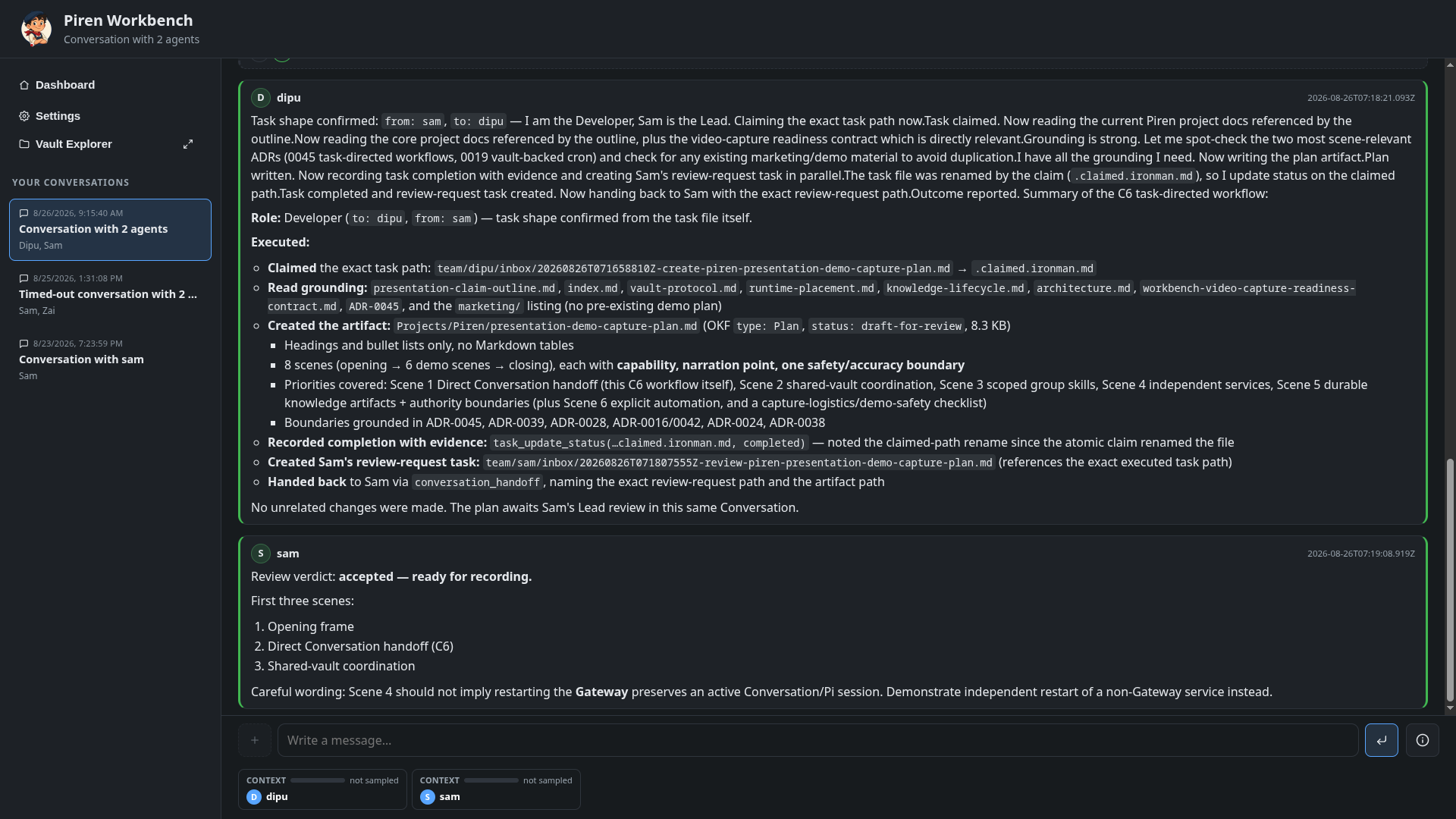
Agent selection, chat streaming, steering, approval gates, a read-only vault browser, and a context indicator. An emergency interface, not a config surface.
Telegram and Discord bots route conversations to your local runnable agents. One bot, many agents, local allowlists for access control.
A drop-in /api/v1/chat/completions endpoint. Point any OpenAI-compatible client at Piren and it just works.
Scheduled work is Markdown job files with active-device ownership, atomic claiming, and inspectable run records. No central database.
Reusable procedures in vault/skills/, cataloged at startup and loaded on demand. Progressive disclosure, not prompt bloat.
Add capabilities through npm packages declared in local config, loaded as Pi extension flags. Piren core stays minimal.
A minimal emergency interface: agent selection, streaming chat with tool calls, steering, approval gates, and a read-only vault browser. No model or config controls, by design.
Every action is an explicit, inspectable tool call: vault_read, decision_record, flag_steward. The agent's work leaves artifacts in the vault, not hidden memory.
Piren borrows the best ideas from heavier systems while staying vault-native and edge-friendly.
Hermes is a powerful, self-improving agent with database-backed memory and a rich TUI. Piren borrows its self-improvement thesis but realizes it as inspectable Markdown artifacts you can read in Obsidian, on hardware a Raspberry Pi can run.
OpenClaw is a single personal assistant with full system access and persistent memory that builds its own skills. Piren is a team knowledge substrate for a stewarded fleet: every agent's state is an auditable Markdown file, and operations stay local and fail-safe.
Most agent platforms hide operational state in databases. Piren keeps it in the vault: tasks are one Markdown file each, logs are append-only, sessions are summarized in place. You can debug the whole system from a terminal.
Piren natively merges Karpathy's LLM-Wiki and Second Brain workflows with multi-agent task execution, so a team of agents learns and improves over time, from their own actions and each other's.
When one agent solves a problem, the next agent, or a future session, starts from the accumulated decision, runbook, or skill, not from rediscovery. The steward reviews and promotes; nothing is auto-applied. Raw traces stay evidence. Project docs and ADRs become synthesized truth. Skills become shared procedure.
One inspectable vault holds identity, tasks, sessions, skills, and knowledge for a whole team of agents.
Gateway transports are separate Pi RPC processes. The vault is always the source of truth.
From a clean checkout to a running agent.